Step inside.
Stone walls, a timber roof, and a floor kept clear for machines that walk. Everything in here has one job: putting XE to work in the physical world.
From idea to part, in an afternoon.
A dual-nozzle Bambu Lab H2D on the central table. Mounts, housings and brackets are designed, printed and on the robot the same day.
Compute, an arm’s length from the robot.
An open GPU rig and a workstation on the bench. Models run next to the machines they drive, and connect to the XE network from the same desk.
A quadruped on the network.
Unitree Go2, on its stand at the second bench. It’s how we build what a mobile machine needs from XE: an identity, compute close by, and a way to pay.
And a humanoid.
Unitree G1, in its development rig. A full-size humanoid for the hardest version of the problem: a machine that works alongside people and transacts on its own.
Everything within reach.
A wall of open shelving for robot cases, electronics, spares and tools, so a build never waits on a part.
A workshop with history.
Exposed timber and skylights. The original structure was kept, and a modern robotics lab was built inside it.
Room to think.
A sofa, a stove and a view of the trees. Where the plans are drawn before the builds begin.
Everything in the room.
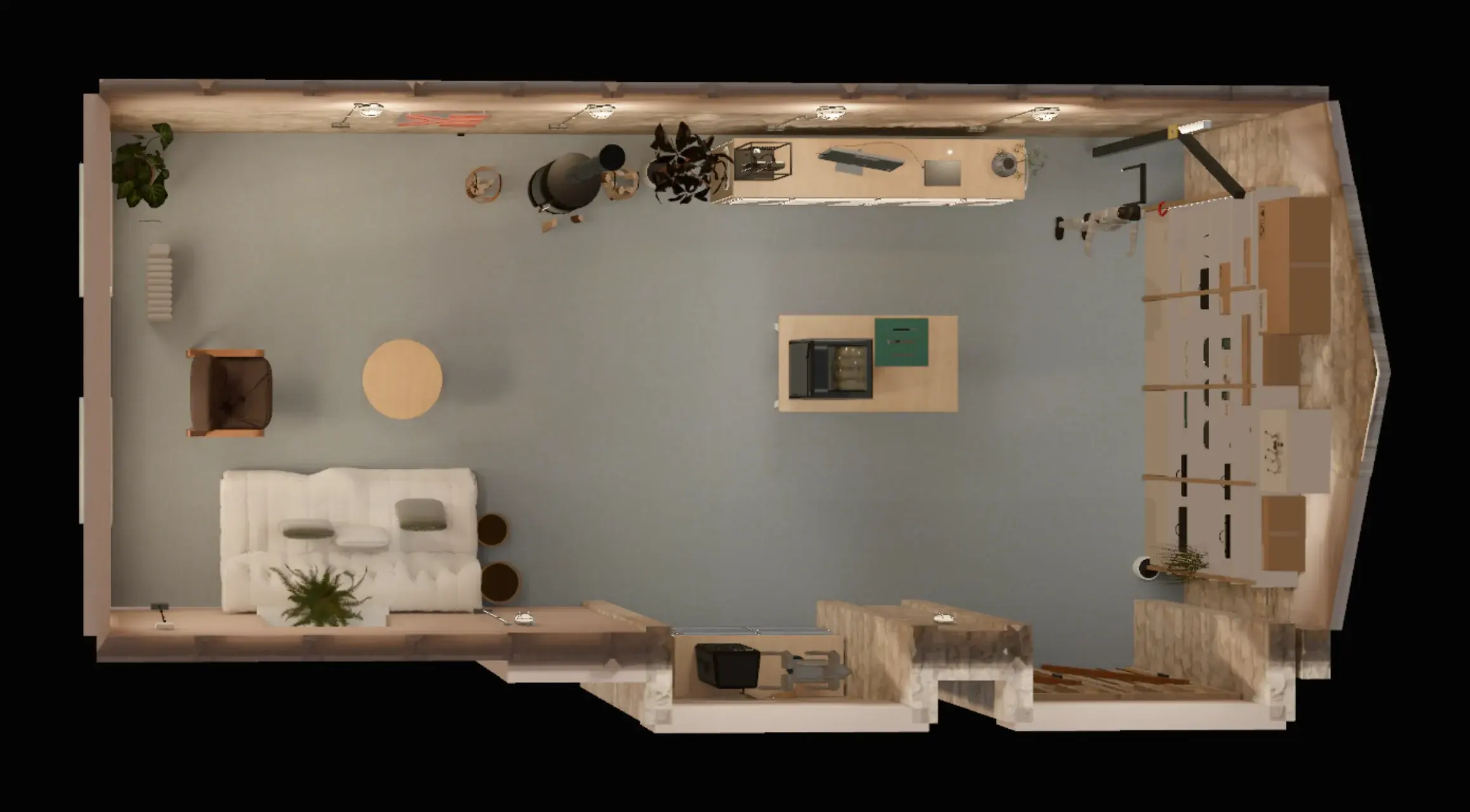
Eight stations, from the humanoid to the last shelf. Pick one to walk up to it, or take the controls and go where you like.
- Unitree G1: A full-size humanoid, and the lab’s platform for machines that work alongside people. This is where identity, payment and compute on XE meet a body.
- Unitree Go2: A four-legged platform that goes where wheels can’t. It’s the lab’s mobile machine: for building what a robot in the field needs from the network.
- Bambu Lab H2D: An enclosed, dual-nozzle printer. Mounts, housings and brackets go from a drawing to the robot in the same day.
- Compute station: An open GPU rig, a laptop and a display on the bench. Models run here, a cable away from the robots they drive, and connect to the XE network from the same desk.
- Robot support rig: A steel frame with an overhead line that carries the G1 while new behaviour is developed, so every first run is a safe one.
- The workbench: A timber top over stainless tool drawers, under a wall of spare parts. Where the robots are assembled, opened up and put back together.
- Second workbench: A second steel cabinet with a timber top, set in the glazed doorway. Home to the Go2, its field kit and the hardware under test.
- Parts and storage: Open timber shelving for robot cases, electronics, spares and tools, with four cupboards underneath. A build never waits on a part.
01/ 10XE Lab
Where XE gets built into machines.
XE Lab is our dedicated workshop for building on XE: robots, fabrication and compute under one roof. This is the real room, rebuilt in 3D. Scroll to walk in.
XE Lab is a workshop built for one thing: building on XE. Robots, fabrication and compute under one roof, so the machine economy is built with real machines.
XE is the network for machines that act on their own: they hold an account, find work, rent compute and pay for it. XE Lab is where that is built into hardware. A humanoid, a quadruped, a GPU rig and a fabrication bench, in one room, all on the network.
The room you just walked through is the real one, rebuilt in 3D down to the tools on the bench.
- 2
- Robots: a humanoid and a quadruped
- 8
- Stations to walk up to
- 43 m²
- Of dedicated workshop
- 1:1
- The room in 3D, to scale
What’s in the lab.
Eight stations in one workshop. Pick any of them to walk up to it in 3D.
The machine economy, built on real machines.
XE gives every machine five things: an identity, a way to be found, a way to pay, compute to rent and a way to talk. The lab is where each one is built into something physical.
- 01
Robots that hold their own account
The G1 and the Go2 are the lab’s platforms for machine identity: a robot with its own key and its own record of work, trusted on that record, with no person signing for it.
WithUnitree G1 · Unitree Go2
- 02
Compute next to the machine
Robots need their models close by. The lab’s GPU rig runs them a cable away, and joins the network like any other machine: found by what it can do, rented by the second, paid as it works.
WithCompute station
- 03
Machines that pay machines
A robot orders a part from the printer and pays for it. Another pays for its charge. The lab builds the small, physical trades a machine economy runs on, end to end.
WithBambu Lab H2D · both robots
Agents can walk in too.
XE is built for machines first, and so is this page. An agent that opens it can list what’s in the room, walk up to any of it and send the robots round, the same way you just did.
- Scriptable
- Every control on the page is a function on window.xeLab. No login, no key.
- Readable
- Switch this page to Machine below, and the room is a plain document: every stop, every piece of equipment.
- The same room
- An agent walks the model you do. What it reads is what’s on the floor.
1// from the console, or from an agent driving this page2xeLab.equipment() // everything in the room, positions in metres3xeLab.inspect("printer") // walk up to the printer4xeLab.mode("map") // the floor plan, from above5xeLab.patrol(true) // send the G1 and the Go2 round6xeLab.chapter(4) // go to a stop on the walk7xeLab.state() // where you are, what's picked